
Understanding Business Email Compromise: Risks, Trends, and Prevention Strategies
Published on June 12, 2026

AUTHOR
Eric Wester, AAP, AFPP, APRP, NCP
Director of Member Services
Business Email Compromise (BEC) remains one of the most significant fraud threats facing organizations and financial institutions today. Unlike many cyberattacks that rely on malware or system vulnerabilities, BEC schemes are rooted in social engineering, using deception and impersonation to manipulate employees into taking seemingly legitimate actions that can result in significant financial loss.
In recent years, BEC attacks have continued to grow in both frequency and sophistication. Cybercriminals are becoming increasingly adept at mimicking trusted contacts such as executives, vendors, and business partners, often leveraging compromised or spoofed email accounts to make their communications appear authentic. As a result, organizations of all sizes are finding themselves at heightened risk, particularly those involved in processing payments or managing sensitive financial information.
For financial institutions and the organizations they serve, understanding the evolving nature of BEC is critical. These schemes not only impact internal operations but also pose broader risks across the payments ecosystem, making awareness and prevention a shared responsibility.
What Is Business Email Compromise and How Is It Evolving?
BEC is a type of cyber-enabled fraud in which criminals manipulate legitimate business processes to redirect payments or obtain sensitive information. These schemes often begin with email account compromise or spoofing, allowing attackers to convincingly pose as trusted contacts. Once inside a communication flow, they exploit routine financial activities such as invoice processing or vendor payments to introduce fraudulent requests that appear normal.
A defining characteristic of BEC is the level of planning involved. Attackers frequently monitor email conversations over time to understand organizational roles, approval processes, and transaction patterns. This allows them to time their requests strategically and align them with real business activity, reducing the likelihood of detection. Requests often involve changes to payment instructions, urgent wire transfers, or updates to vendor banking details.
BEC continues to evolve as criminals expand both their methods and targets. In addition to traditional email-based attacks, fraudsters are increasingly using multiple channels, such as text messaging or phone calls, to support their schemes and add credibility. They are also diversifying their approaches, targeting payroll systems, smaller dollar transactions, and vendor relationships to exploit weaknesses across the payment lifecycle.
Business Email Compromise Trends Over Time
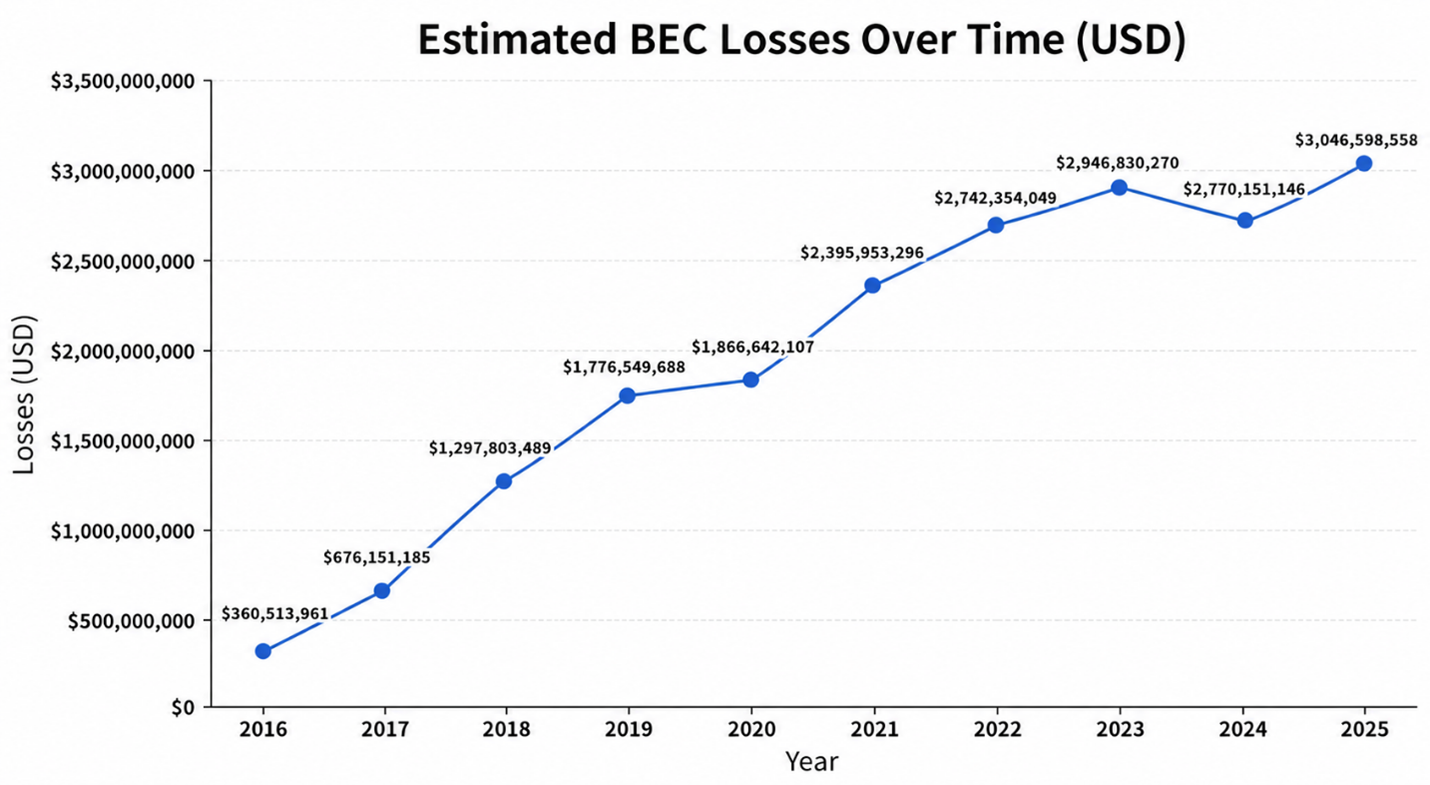
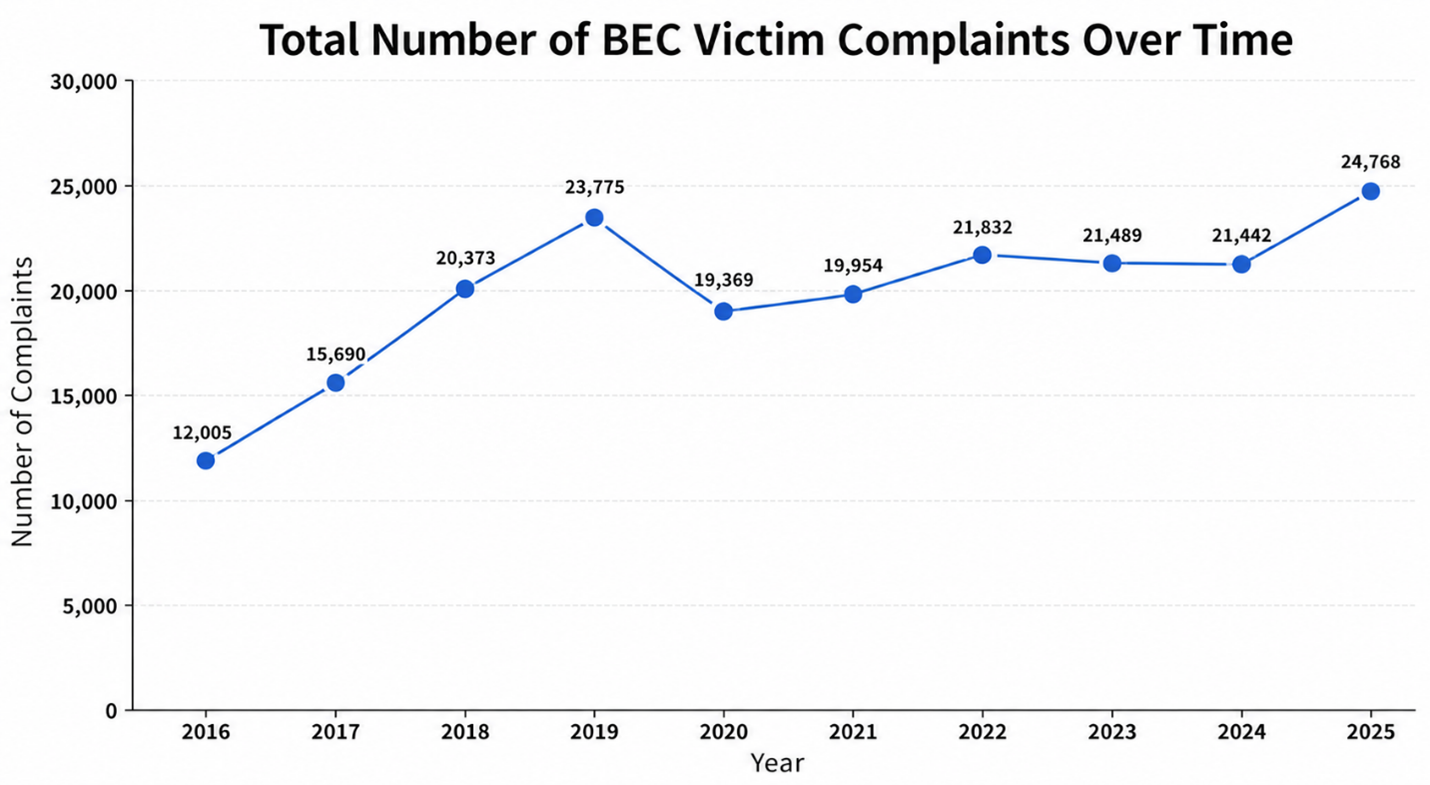
BEC has shown a consistent upward trend over the past decade, both in terms of reported incidents and financial losses. According to data published by the FBI’s Internet Crime Complaint Center (IC3), BEC has remained one of the costliest forms of cybercrime year after year, with annual losses steadily increasing as attackers refine their tactics and expand their reach. What began as relatively simple email spoofing has evolved into a multibillion-dollar threat impacting organizations of all sizes.
A key trend is the sustained growth in financial impact, even as awareness of BEC has increased. This reflects the effectiveness of these schemes and the ability of cybercriminals to adapt quickly, targeting new payment processes, industries, and communication channels. Financial institutions continue to see the downstream effects, often working with business clients to attempt to recover funds or prevent fraudulent transactions before they are completed.
The charts below illustrate the general upward trajectory of estimated BEC related losses and the number of victim complaints over time, highlighting why this threat remains a top concern across the payments ecosystem.
How Can Organizations Protect Against Business Email Compromise?
Protecting against BEC requires a layered approach that combines strong internal controls, employee awareness, and effective use of technology. Because BEC targets human behavior and business processes, organizations should focus on strengthening how financial transactions and sensitive requests are verified. This includes implementing dual approval requirements for payments, enforcing callback procedures using known contact information, and closely scrutinizing any requests that involve changes to payment instructions or account details.
Employee education also plays a critical role in prevention. Staff should be trained to recognize common BEC indicators, such as unexpected urgency, slight changes in email addresses, or requests that deviate from normal procedures. Regular training and simulated phishing exercises can help reinforce awareness and ensure that employees are prepared to identify and report suspicious activity before it results in financial loss.
In addition to procedural and training measures, organizations should leverage technical safeguards such as multi-factor authentication (MFA), email filtering, and domain monitoring to reduce the likelihood of account compromise and spoofing. Financial institutions can further support their clients by promoting awareness, encouraging strong controls, and maintaining clear processes for quickly reporting and responding to suspected fraud. Together, these strategies create a more resilient defense against an increasingly sophisticated threat.
UMACHA is Here to Support You
BEC continues to pose a significant and evolving risk to organizations and financial institutions, driven by increasingly sophisticated tactics and a strong reliance on human trust. As these schemes grow in complexity and financial impact, it is critical for organizations to understand how BEC works, recognize warning signs, and implement layered controls that address both technical vulnerabilities and human behavior.
While no single solution can eliminate the risk, combining strong internal procedures, employee education, and proactive collaboration with financial institutions can significantly reduce the likelihood of a successful attack. Ongoing awareness and vigilance are key, as cybercriminals will continue to adapt their methods to exploit gaps in processes and communication.
UMACHA is committed to helping organizations strengthen their defenses against BEC. Members have access to valuable resources, including a comprehensive Business Email Compromise (BEC) Response Action Plan and a Business Email Compromise (BEC) Holiday-Season Toolkit designed to address periods of increased fraud risk. To learn more about the full benefits of membership, visit the Become a Member page.
Stay connected with Eric Wester and UMACHA on LinkedIn!